Service · Tank Water
Water tank waterproofing across Byron Bay and the Northern Rivers.
Away from town water, the tank is the supply. When a concrete tank starts leaking, the fix has to keep it holding water — not just stop the stain on the wall. We repair tanks by injection, or by positive- and negative-side waterproofing where the lining itself has broken down.

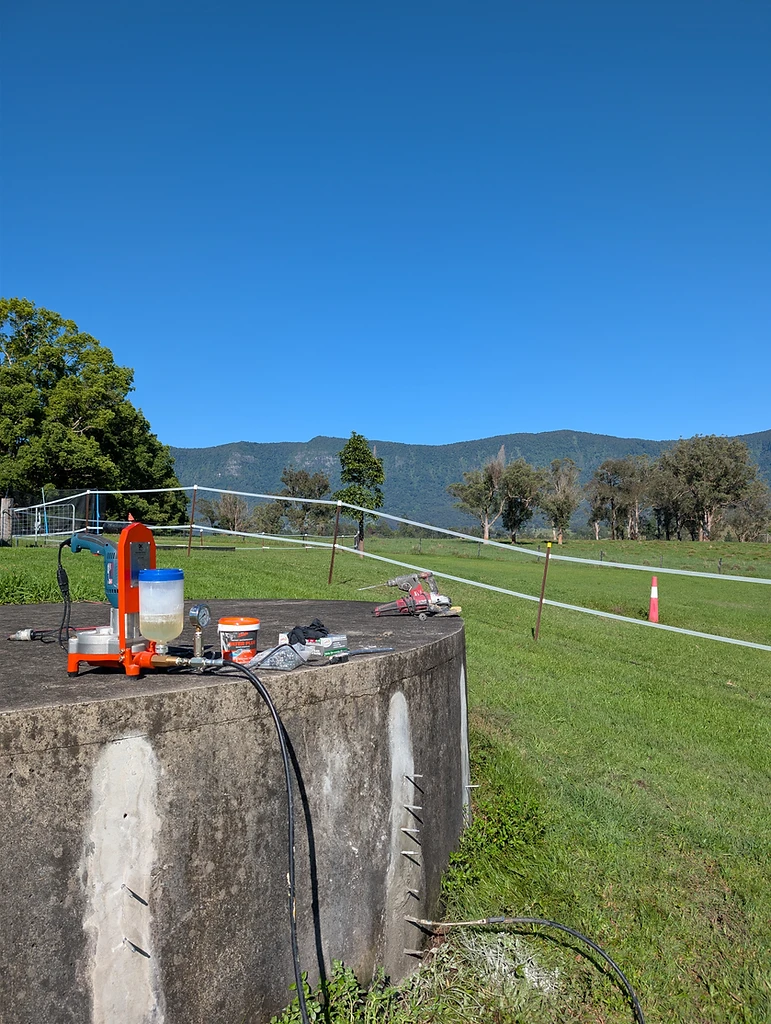

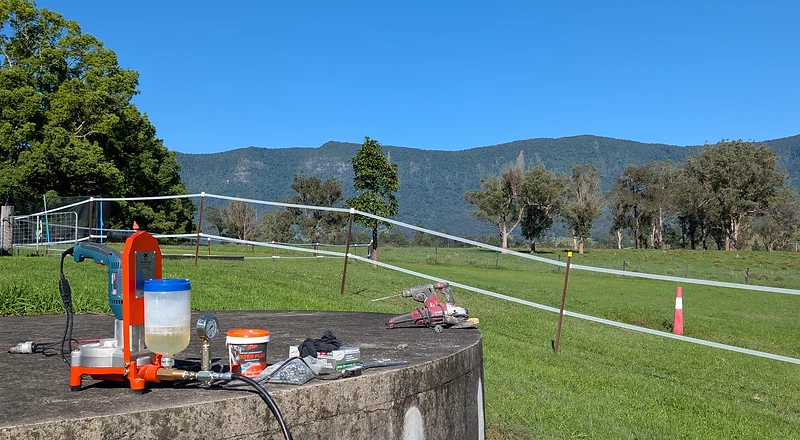
A tank leak is a supply problem.
Through the hinterland and the rural blocks behind Byron Bay, most properties run on tank water. A leak in a concrete tank is rarely cosmetic: it drains storage you've paid to fill, saturates the ground around the tank, and in an in-ground tank it shows up as damp in whatever is built beside or below it.
Most tank leaks start at a defect rather than across the whole surface — a horizontal crack from settlement, a cold joint where two pours met, the collar around an inlet or outlet, or a penetration that was never sealed properly. Those are the leaks injection is built for, because the resin goes into the concrete section itself and closes the path the water is using.
Where the tank has aged and the surface has broken down broadly, a membrane is the better answer — from the water side if the tank can be emptied and prepared, or from the dry side if it can't. We'll tell you which one your tank needs, and if it isn't worth repairing, we'll say that too.
Three approaches
Positive-side, negative-side, or injection.
The right method depends on where the water is entering, whether the tank can be taken out of service, and how much of the structure has broken down. On tanks, these are often used together rather than as alternatives.
Positive-side
A membrane applied to the wet face — the inside of the tank, or the outside of the wall where it's exposed and reachable.
Suits when
- The tank can be drained, dried and prepared
- The lining is broadly deteriorated, not leaking at one point
- Access and reinstatement are straightforward
Limits
The tank comes out of service, the substrate is prepared and the lining reinstated.
Negative-side
A coating or membrane applied to the dry face — the outside of the tank wall, sealing it from behind the water.
Suits when
- The tank can't be drained, or the inside is difficult to access
- Water is seeping across a broad area rather than a single defect
- The external face is exposed and sound enough to take a coating
Limits
It stops water entering the surrounding structure; it doesn't repair the concrete itself.
Injection
Resin pumped into the wall through drilled ports, filling cracks, cold joints and penetrations from the inside of the concrete out.
Suits when
- The leak tracks through a crack, joint or penetration
- Water is running under hydrostatic head
- The tank needs to stay in service
Limits
It seals the leak path it's injected into — not a whole-surface renewal.

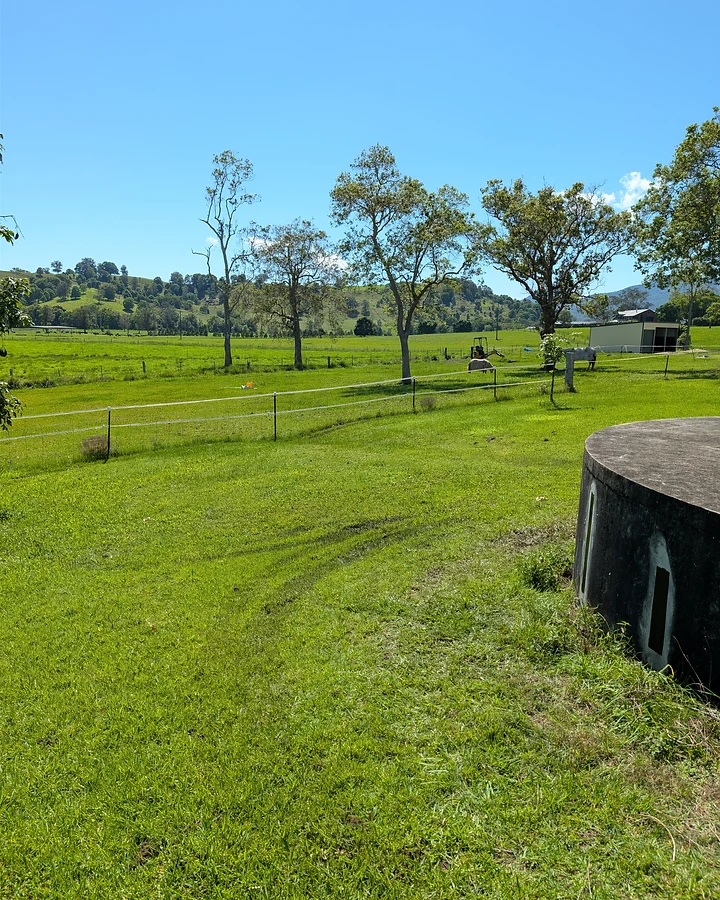
Ports cut back and patched — the crack sealed inside the concrete section, not over it.
Method
What injection work on a tank involves.
Ports are drilled along the defect at an angle so they intercept it mid-depth in the wall. Mechanical packers go into the holes and the pump is connected. Resin is injected under pressure, travelling through the crack or joint void until it reaches the surface — that travel is how we know the void is charged.
A hydrophilic resin chases active water flow and cures hard against it; hydrophobic resin gives a flexible seal that accommodates minor movement. On tanks with a sustained head of water, both are often used in sequence across the same defect.
Work is typically contained to a day on site, with the packers cut back and the holes patched afterwards. No demolition, no lining removal, no scaffolding around a round tank.
Before you commit
Repair the concrete, or replace it with poly?
Three things decide the answer, and only one of them is the leak itself.
Concrete or poly
Before a method is chosen, the tank itself is the decision. A poly tank is cheap to buy, quick to swap, and if the site is level, above ground and a truck can reach it, that's often the simpler spend. A concrete tank is worth repairing when the shell is sound and the leak sits at a defect — it's already sited, already plumbed, and its thermal mass keeps water cooler. Where the concrete is breaking down through the wall, no coating will hold it and replacement is the honest answer.
What's behind the wall
A buried or partly buried tank can take water from the ground as well as lose it. If the outside face is holding back soil and groundwater, that face usually needs treatment too, or water crosses the wall section and shows up inside no matter how well the interior is sealed. In most cases that means excavating to the wall and treating the dry face. Where excavation isn't practical, injection into the wall itself is what's left, and a new interior lining on its own will keep giving trouble.
Confined space, real risk
Tanking from the water side means working inside the tank. A drained concrete shell is a confined space: entry permits, atmosphere monitoring, ventilation, a rescue plan, and the time it takes to dry the substrate before any product goes on. It is labour intensive and it carries genuine risk, which is why it isn't the cheap option. Done properly, with products rated for potable water and applied to a prepared surface, it's the approach that gives a concrete tank years of worry-free service.

Where we work
Based in Byron Bay. Tank repairs across the Northern Rivers, and down to the Gold Coast.
Byron Bay · Bangalow · Mullumbimby · Brunswick Heads · Ocean Shores · Federal · Clunes · Uki · Nimbin · Lennox Head · Ballina · Alstonville · Lismore · Kyogle · Casino · Murwillumbah · Pottsville · Tweed Heads
Tank water questions
Tell us about the tank.
Concrete or in-ground, full or empty, leaking at a crack or across the surface — send the details and a photo if you have one, and we'll come back within one business day.
0431 522 689