Service
Diagnose the leak before you fix it.
Water stains and visible leaks rarely sit where the water is getting in. Thermal imaging, moisture mapping and non-destructive testing find the actual entry path — so the repair targets the cause, not the symptom, and the fix is done once.
A stain on a ceiling, a damp patch on a wall, a puddle in a car park — these are symptoms. The entry point is often metres away, travelling along a slab, a cavity, or a service penetration before it shows up. Specifying a repair from the symptom alone is how the same leak comes back six months later.
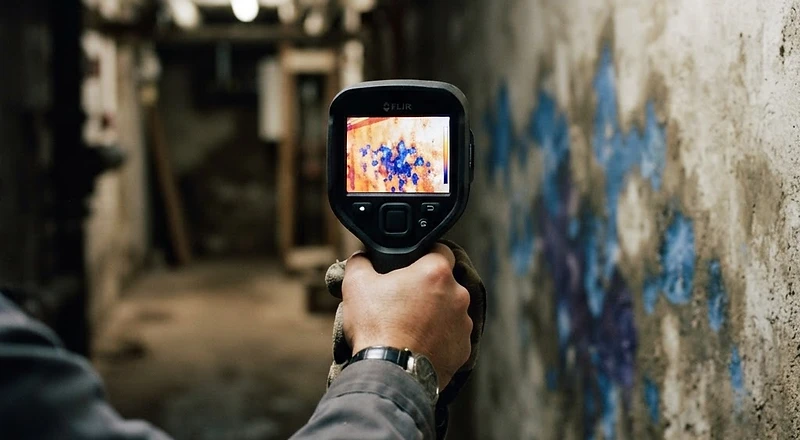
We diagnose first. A thermal imaging camera maps surface temperature across the area — wet materials read cooler, so moisture paths behind finishes show up as clear colour differentials. Moisture meters quantify how wet, and where the wet stops. Where needed, a borescope looks inside the cavity, and diagnostic injection confirms the resin travel path before a full repair is committed.
The result is a report: where the water is getting in, how it's travelling, and what will stop it. That's what strata managers, building managers and asset teams need to justify scope — and what stops you paying for the wrong repair.
Diagnostic equipment
Thermal imaging cameras
Infrared cameras that map surface temperature to reveal moisture paths behind walls, ceilings and slabs — non-destructive.
Moisture meters
Pin and pinless meters to quantify moisture content in concrete, plaster and timber, and map the wet/dry boundary.
Borescopes
Inspection of concealed cavities, wall internals and pipe penetrations through a small access hole.
High-pressure injection pumps
Diagnostic injection to confirm resin travel and seal path before a full repair is specified.
Dye & flood testing
Targeted water testing to reproduce and trace the ingress path under controlled conditions.
Why we diagnose first.
Most remedial waterproofing fails not because the product was wrong, but because the diagnosis was. A membrane patch over a stain seals the finish, not the entry. Injection into the visible crack misses the joint two metres away that's actually feeding it. The water finds another path, and the leak returns.
Diagnosing first costs less than a wrong repair. We carry the kit on site, report what we find, and recommend the right fix — whether that's injection, negative-side waterproofing, or something else entirely. If the answer isn't waterproofing, we'll say so.
Trace the leak.
Tell us where the water's showing up and we'll map the source. Non-destructive diagnosis first, then the right fix.
0431 522 689