Service
Waterproofing for council and government concrete assets.
Water tanks, reservoirs, treatment plants, retaining walls and culverts share a common problem: the water side is buried, submerged, or carrying a live load, so you can't dig from the outside. Polyurethane injection and negative-side systems seal these structures from the inside — without decommissioning the asset.
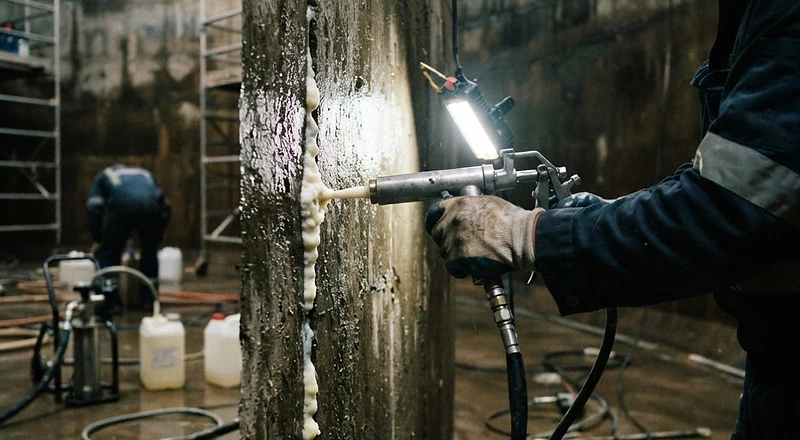
Council and government concrete assets fail at the joints and cracks. In a water tank or reservoir, that means a leak path under sustained head pressure. In a retaining wall or culvert, it means groundwater migrating through the structure and degrading the concrete from within. The conventional fix — excavate, re-membrane, reinstate — is rarely feasible on a live asset.
Polyurethane injection works from the inside face. Resin is driven under high pressure into the crack or joint, where it reacts with water and expands to form a flexible, water-tight seal that holds against hydrostatic pressure. For broader surface ingress, negative-side waterproofing bonds to the internal face of the concrete and resists water pushing through the section.
Because these assets are often occupied, submerged, or critical to service continuity, we diagnose first — thermal imaging and moisture mapping to confirm the ingress path — before specifying a repair. That reporting is what asset and engineering teams need to justify scope and budget.
Assets we work on
Water tanks & reservoirs
Injection to seal cracks and joints in concrete tanks under head pressure, often without full decommissioning.
Treatment plants
Negative-side sealing of process tanks, wet wells and below-grade structures in water and sewage treatment facilities.
Retaining walls
Injection and negative-side systems for council road and rail retaining walls where excavation isn't feasible.
Culverts & bridge abutments
Sealing joints and cracks in concrete drainage structures against groundwater and runoff.
Council basements & lift pits
Below-grade waterproofing for council buildings, depots and community facilities.
Paired with diagnostics
Thermal imaging and moisture mapping to locate the ingress path before specifying repair.
Why injection over relining.
Relining a tank or excavating a retaining wall means taking the asset offline, managing confined-space access, and reinstating finishes — cost and downtime that rarely match the scale of the leak. Injection targets the failure path directly, seals it under pressure, and leaves the asset in service.
Where the concrete is sound and the ingress is localised — a crack, a joint, a penetration — injection is usually the right first move. Where the surface is broadly saturated or the concrete is degraded, a negative-side membrane across the face may be needed. We assess each asset and report before recommending scope.
Discuss an asset.
Send the asset type, location and what's happening. We'll come back within one business day — sooner for active leaks.
0431 522 689