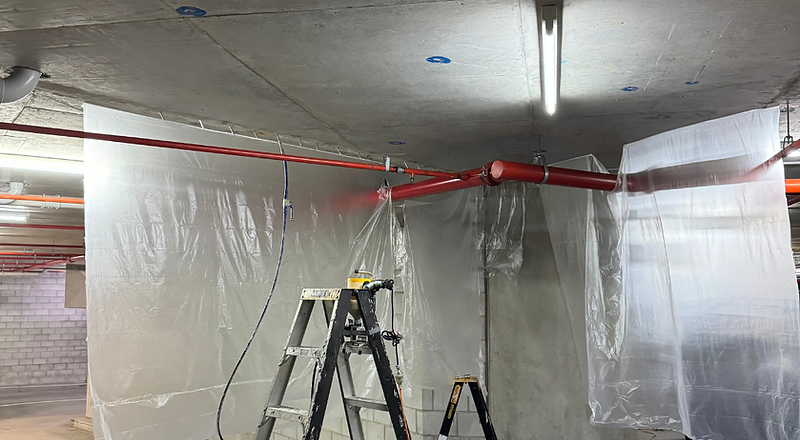
Flagship Service
Polyurethane injection waterproofing — Gold Coast, Tweed and Northern Rivers.
High-pressure resin injection that seals water ingress from within the concrete itself. No excavation, no demolition, no closing the facility. This is the discipline Driftform is built around.
Polyurethane injection seals water ingress from inside the concrete. Rather than excavating to apply a new membrane on the outside, we drill into the structure, install injection packers, and pump a liquid resin under pressure directly into cracks, joints and voids. The resin reacts with water and expands, forming a flexible seal that stops the leak at its source.
For a strata manager on the Gold Coast with a leaking basement car park, or a commercial owner in Tweed with a wet lift pit, this usually means the problem is resolved in hours — no jackhammers, no closed areas, no displaced residents.
Two resins, used together.
Hydrophilic resin
Reacts with water and expands rapidly. Used for active, gushing leaks where the flow needs to stop now. The resin swells on contact with water, fills the crack, and halts the flow within minutes.
Hydrophobic resin
Cures to a stable, flexible seal independent of water. Used for dormant cracks and joints where long-term elasticity matters — it accommodates minor structural movement without losing the seal.
Most jobs use both: hydrophilic to stop the active leak, hydrophobic to keep the seal flexible as the building moves. The selection is based on the leak condition in front of us, not a default system.
Where it's used
Basements and car parks
Leaking construction joints, soffit cracks, wall-to-floor junctions — sealed without closing the facility.
Lift pits
Water ingress that threatens elevator electronics and pit corrosion.
Construction joints
Cold joints between pours — the most common source of below-grade leakage.
Cracks in walls and slabs
From shrinkage cracks to structural cracks with active water.
Retaining walls
Inside-face injection where external excavation isn't feasible.
Void filling
Filling voids behind concrete where water has eroded the substrate, where specified.
When injection is the right call.
Injection is the right first option when the leak is localised — a crack, a joint, a single penetration. The work happens from inside, the area stays in use, and the job takes hours instead of weeks. There's no demolition and no reinstatement cost.
Excavation and membrane replacement is necessary when the failure is broad — when the whole membrane has degraded, not just a single joint. That work takes days, may require closing the area, and costs significantly more.
We'll tell you which situation you're in. If injection won't hold, we'll say so and quote the membrane work instead.
How a job runs
01 — Inspect
We visit the site, find the water entry path, and assess whether injection is the right fix or whether the failure is broader than it looks.
02 — Isolate and drill
We map the crack or joint, mark packer spacing based on crack width and substrate depth, then drill at an angle to intercept the crack mid-depth and install mechanical packers.
03 — Inject
Resin goes in under controlled pressure, starting at the lowest point and working up. We watch for resin travel and surface return to confirm the crack is filled.
04 — Document
Packer locations, resin type and volume are recorded and provided for your building file — a baseline to monitor if the joint moves further.
Most injection jobs are finished in hours. The area can remain in use throughout.
Strata and commercial first.
If you manage a Gold Coast high-rise with a leaking basement, a Tweed commercial building with a wet lift pit, or a Northern Rivers strata property with a cracked retaining wall — this is likely the most efficient path to a dry structure. We also take on selected residential work where there's a real leak that warrants a specialist.
Tell us about the leak.
Send a few details and we'll come back within one business day. If water's entering now, call us directly.
0431 522 689