Case Study · Polyurethane Injection
Concrete water tank crack injection — Byron Bay, Northern Rivers.
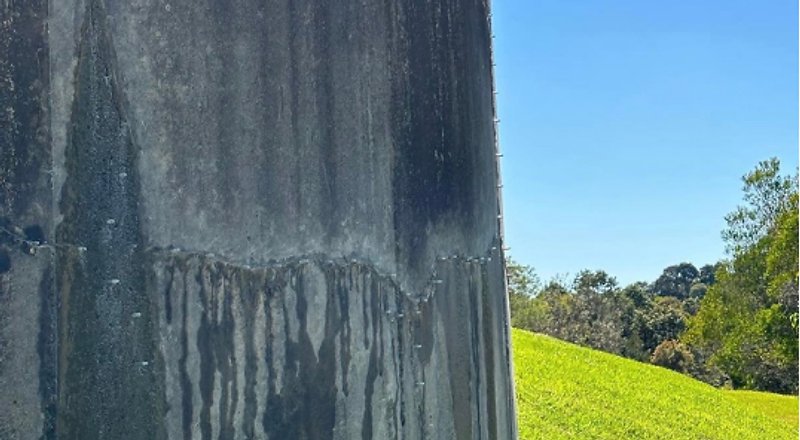
An active leak through a horizontal crack in a concrete water tank, sealed with polyurethane injection from the exterior face without dismantling the structure.
The building
A concrete water tank on a property in Byron Bay, Northern Rivers. The tank had developed a horizontal crack across the wall, with water tracking through and long-term mineral staining running down the concrete face.
The problem
The crack was active — water was passing through the tank wall under hydrostatic head. The mineral leaching visible down the face indicated sustained seepage over time. A surface coating on the exterior would not hold under pressure; the leak path needed to be sealed within the concrete section itself to restore the tank's integrity.
The approach
Polyurethane injection was the correct method. It seals the crack internally, within the concrete, rather than relying on a surface membrane that would detach under constant hydrostatic pressure. We could work from the exterior face of the tank, drilling to intercept the crack mid-depth, without dismantling the structure or lining.
The work
We drilled injection ports along the horizontal crack at an angle to intercept it within the wall, installed mechanical packers, and injected hydrophilic resin to chase the active flow, followed by hydrophobic resin for a flexible, long-term seal. The resin expanded as it cured, filling the crack void from the inside out.
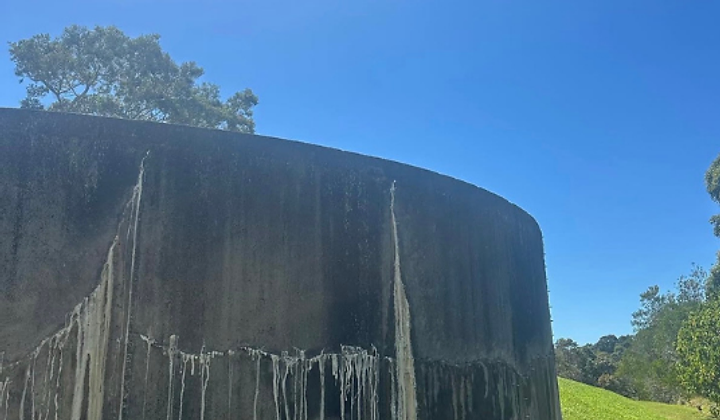
Resin going off along the crack line — the expanded material visible as pale streaks confirms the void was fully charged.
The result
The crack was sealed and the tank returned to service. The cured resin is visible in the documentation — the expanded material filling the crack line confirms the void was fully charged and the leak path closed.
Got a leaking tank or structure?
Send a few details and we'll come back within one business day. Active leaks — call us directly.
0431 522 689